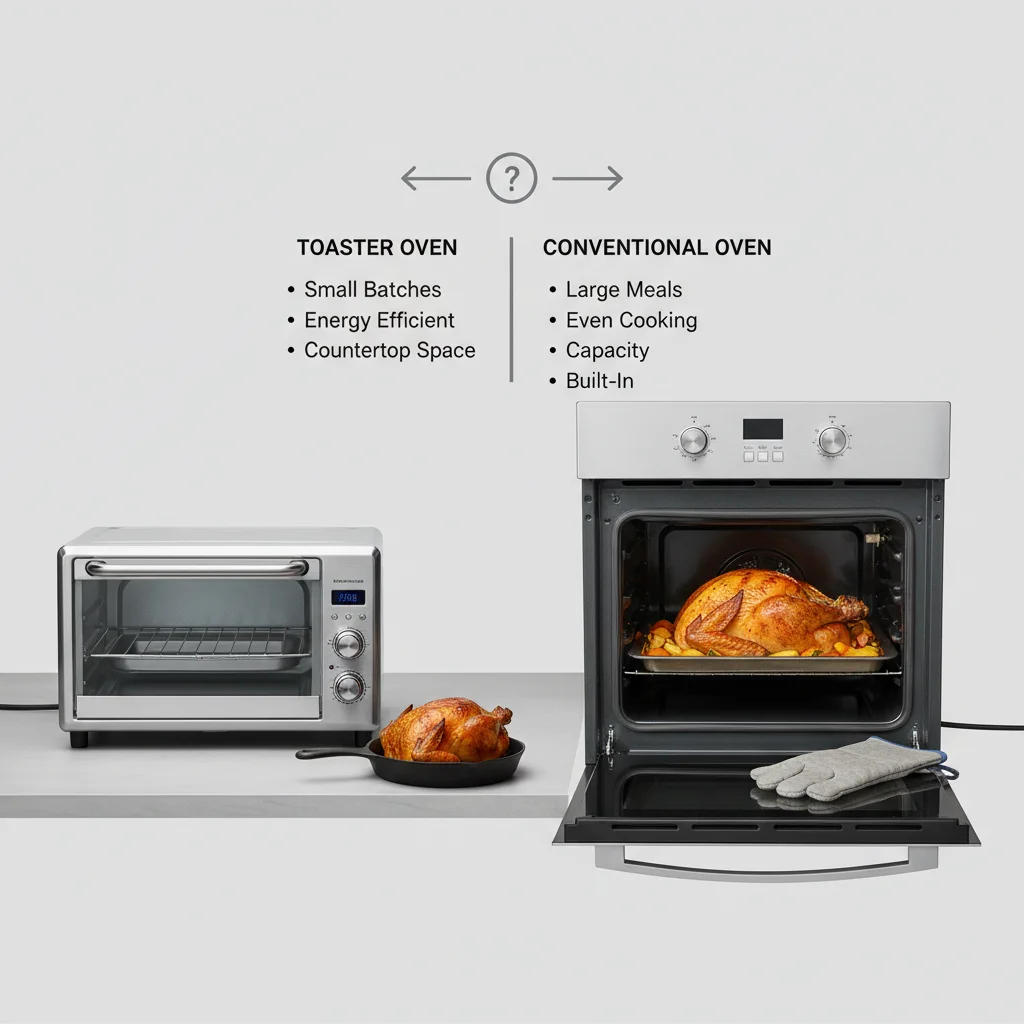
For many home cooks, the choice between a toaster oven and a conventional oven depends on household size, kitchen space, and cooking habits. A toaster oven is ideal for smaller households, limited spaces, and quick tasks like toasting, reheating, and small-batch baking, offering greater energy efficiency for these uses. In contrast, a conventional oven is essential for larger families, extensive baking, and roasting big cuts of meat due to its superior capacity and consistent heat distribution.
Size and Space Considerations
One of the most immediate distinctions between a toaster oven and a conventional oven is their physical footprint. Toaster ovens are compact countertop appliances, typically ranging from 0.3 to 1.0 cubic feet in interior capacity. This makes them ideal for apartments, dorm rooms, or kitchens with limited counter space. They are designed to be easily accessible and can be moved if needed. Conventional ovens, on the other hand, are much larger, often integrated into kitchen cabinetry or standing as a full-size range. Their interior capacity usually starts around 2.5 cubic feet and can go up to 6 cubic feet or more, requiring dedicated space and often professional installation. For see our toaster ovens recommendations on this site.
The smaller size of a toaster oven means it heats up much faster than a conventional oven, saving time and energy for quick meals. However, this also limits the size of dishes and quantities of food you can cook. A conventional oven’s larger cavity allows for multiple racks and bigger bakeware, accommodating family-sized meals and holiday feasts.
Energy Efficiency and Cost
When it comes to energy consumption, toaster ovens generally have a significant advantage for smaller tasks. Because they are smaller and heat up quicker, they use less electricity per use compared to preheating and operating a full-sized conventional oven. For example, heating a toaster oven to 350°F might take 5-7 minutes and consume a fraction of the energy a conventional oven would for the same temperature. This can lead to noticeable savings on your electricity bill over time, especially if you frequently cook smaller portions or reheat leftovers.
However, if you’re cooking a large meal that requires multiple dishes or a big roast, a conventional oven becomes more energy-efficient than trying to cook in multiple small batches in a toaster oven. The cost of the appliances themselves also varies; basic toaster ovens can be found for under $50, while conventional ovens typically start at several hundred dollars and can easily exceed a thousand, not including installation costs.
Cooking Capabilities and Versatility
|
Our Picks for the Best Toaster Oven in 2026
As an Amazon Associate I earn from qualifying purchases.
|
||
| Num | Product | Action |
|---|---|---|
| 1 | BLACK+DECKER TO3250XSBD 8-Slice Extra Wide Convection Countertop Toaster Oven, Includes Bake Pan, Broil Rack & Toasting Rack, Stainless Steel/Black |

|
| 2 | BLACK+DECKER Crisp 'N Bake Air Fry Countertop Convection Toaster Oven, Medium Capacity, 4-Slice, 5-in-1, Fits 9” Pizza, 30-Min Timer, Bake, Broil, Air Fry, Toast, Keep Warm, Stainless Steel |
|
| 3 | BLACK+DECKER 4-Slice Toaster Oven with Natural Convection, Stainless Steel, TO1760SS (TO1760SST-1) |
|
| 4 | Cuisinart Custom Classic Toaster Oven Broiler, 1800 Watt Countertop Toaster Oven to Bake, Broil, and Toast, Non-Stick Interior, Consistent Toast Control, Brushed Stainless Steel/Black, TOB-40N |
|
| 5 | Oster 10 Function Air Fryer Oven Toaster Oven Countertop |
|
| 6 | Hamilton Beach 6 Slice Convection Toaster Oven With Easy Reach Roll-Top Door, Bake, Broil & Toast Functions, Auto Shutoff, Silver (31123DA) |
|
| 7 | BLACK+DECKER Crisp 'N Bake Air Fryer Countertop Convection Toaster Oven, Large Capacity, 6-Slice, 5-in-1, Fits 12” Pizza, 60-Min Timer, Bake, Broil, Air Fry, Toast, Keep Warm, Stainless Steel |
|
| 8 | BLACK+DECKER TO1313SBD Toaster Oven, 15.47 Inch, Silver |
|
| 9 | Hamilton Beach 6 Slice Countertop Toaster Oven With Easy Reach Roll-Top Door, Bake, Broil & Toast Functions, Auto Shutoff, Silver (31127D) |
|
| 10 | TOSHIBA AC25CEW-BS Large 6-Slice Convection Toaster Oven Countertop, 10-In-One with Toast, Pizza and Rotisserie, 1500W, Black Stainless Steel, Includes 6 Accessories |
|
Both types of ovens can bake, roast, and broil, but their effectiveness and capacity for these functions differ. Toaster ovens excel at tasks like toasting bread, bagels, and frozen waffles, reheating pizza slices, baking cookies, and roasting small portions of vegetables or chicken. Many modern toaster ovens also include air frying, convection, and dehydrating functions, adding to their versatility for specific cooking needs.
Conventional ovens are the workhorses for larger-scale cooking. They are perfect for baking multiple trays of cookies, roasting a whole turkey or chicken, preparing casseroles, and baking large cakes or pies. Their consistent and even heat distribution across a larger cavity is crucial for complex baking and roasting projects. While some conventional ovens offer convection features, the primary advantage lies in their sheer capacity and ability to handle substantial quantities of food simultaneously.
Maintenance and Cleaning
Cleaning a toaster oven is generally a simpler and quicker process due to its smaller size. Removable crumb trays make it easy to dispose of crumbs, and the interior can often be wiped down with a damp cloth and mild soap. Some models even feature non-stick interiors for easier cleaning. Regular cleaning is important to prevent grease buildup and maintain efficiency.
Conventional ovens, especially those without self-cleaning features, can be more challenging to clean. Spills and splatters can bake onto the interior surfaces, requiring specialized oven cleaners and more effort to remove. Self-cleaning cycles, while convenient, can produce strong fumes and consume a significant amount of energy. Regardless of the type, consistent maintenance will prolong the life of your appliance.
Who Should Choose Which?
The choice between a toaster oven and a conventional oven ultimately depends on your lifestyle, cooking habits, and kitchen setup. Consider these points:
- Toaster Oven: Ideal for singles, couples, small families, dorm residents, or those with limited kitchen space. Perfect for quick meals, reheating, toasting, and small-batch baking. Excellent for energy efficiency on smaller tasks.
- Conventional Oven: Essential for larger families, frequent entertainers, avid bakers, or those who regularly cook large meals. Provides ample capacity for roasts, multiple dishes, and extensive baking projects.
- Both: Many households find value in having both appliances. A toaster oven can handle daily small tasks, saving the conventional oven for larger, less frequent cooking, thereby maximizing efficiency and convenience.
Ultimately, understanding your specific needs will guide you to the best choice. For many, a toaster oven serves as an invaluable daily companion, while the conventional oven remains the cornerstone for bigger culinary endeavors.
Frequently Asked Questions
What are the main differences in size between these two ovens?
Toaster ovens are compact countertop appliances, typically 0.3 to 1.0 cubic feet, making them suitable for small spaces. Conventional ovens are much larger, usually 2.5 to 6 cubic feet or more, requiring dedicated kitchen space and often professional installation.
Which type of oven is more energy-efficient for daily use?
Toaster ovens are generally more energy-efficient for smaller tasks because they heat up faster and use less electricity per use. For example, heating a toaster oven to 350u00b0F takes only 5-7 minutes, consuming less energy than a full-sized conventional oven.
What cooking tasks are toaster ovens best suited for?
Toaster ovens excel at tasks like toasting bread, reheating pizza, baking small batches of cookies, and roasting small portions of vegetables or chicken. Many modern models also offer air frying, convection, and dehydrating functions.
When should I choose a conventional oven over a toaster oven?
A conventional oven is essential for larger families, frequent entertainers, or those who regularly cook big meals. It provides ample capacity for roasting whole turkeys, baking multiple trays of cookies, and preparing large casseroles simultaneously.
Is it beneficial to own both a toaster oven and a conventional oven?
Yes, many households find value in owning both appliances. A toaster oven can handle daily small tasks, saving the conventional oven for larger, less frequent cooking, thereby maximizing efficiency and convenience for various culinary needs.

This was super helpful! I always thought toaster ovens were just for toast, but learning about their capacity for small-batch baking and roasting really opened my eyes. We’re a family of two, and our conventional oven feels like overkill for most weeknight meals. I’m now considering one to handle those smaller meals and save on electricity.
I’ve been debating getting a toaster oven for ages, and this really helped me make up my mind. My apartment kitchen is tiny, and I mostly cook for just myself, so the idea of saving energy on small tasks like reheating leftovers or baking a couple of cookies is a huge plus. I’m definitely going to look into one of the models around 0.6 cubic feet.
While I appreciate the energy efficiency point for smaller tasks, I found that my toaster oven struggles with consistent heat distribution when I try to bake anything more substantial than toast. It’s great for quick snacks, but for actual small-batch baking, I still find myself reaching for my conventional oven. Maybe it’s just my specific model, but it’s a bit of a letdown.
As someone with a larger family, I totally agree that a conventional oven is essential for big cuts of meat and extensive baking. However, we recently added a toaster oven for those quick morning bagels and reheating pizza slices, and it’s been a game-changer. It keeps the main oven free and heats up so much faster for those smaller jobs. Best of both worlds!