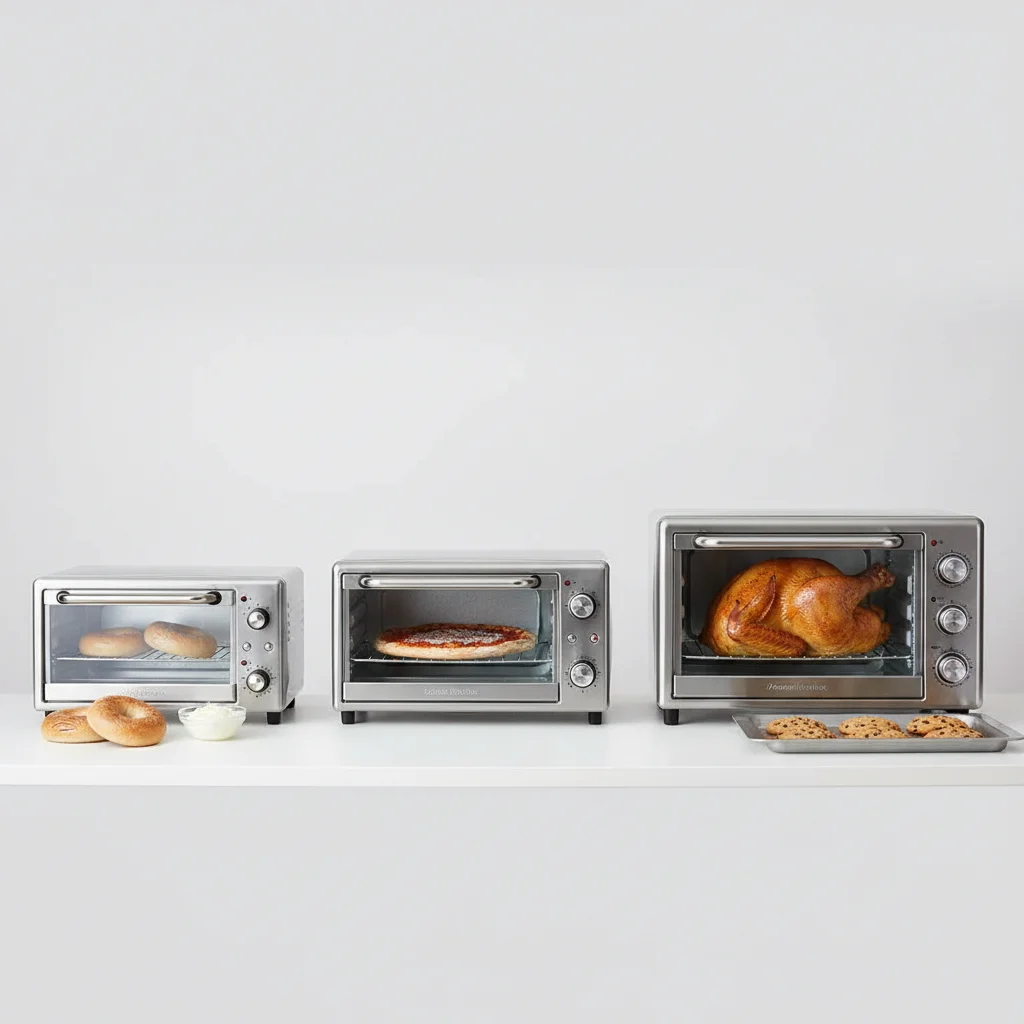
Choosing the right toaster oven capacity is crucial for efficient cooking and kitchen space management. Generally, toaster ovens range from 0.3 to 1.5 cubic feet, with the ideal size depending on your household needs and the types of dishes you plan to prepare. A smaller 0.3-0.5 cubic foot model is perfect for single servings or light toasting, while larger 0.8-1.5 cubic foot units can handle whole chickens or 12-inch pizzas.
Understanding Toaster Oven Sizes
Toaster ovens come in various sizes, often measured in cubic feet or by the number of bread slices they can toast. Compact models, typically 0.3 to 0.5 cubic feet, are ideal for individuals or couples with limited counter space. These can usually toast 4 slices of bread or bake a few cookies. Mid-sized toaster ovens, ranging from 0.6 to 0.8 cubic feet, are versatile enough for small families, accommodating 6 slices of bread or a small frozen pizza. For larger families or those who frequently entertain, full-sized toaster ovens, 0.9 cubic feet and above, offer the most flexibility, often fitting a whole chicken or a 9×13 inch baking pan.
Matching Capacity to Your Cooking Habits
Your cooking habits should heavily influence your toaster oven capacity choice. If you primarily use it for toast, bagels, or reheating small portions, a compact model will suffice. However, if you envision baking casseroles, roasting vegetables, or even cooking a small turkey, a larger capacity is essential. Consider the dimensions of your most frequently used bakeware. A toaster oven that can comfortably fit a standard 9×13 inch baking dish will offer significant utility for family meals. Conversely, if you live in a small apartment and only need to warm up leftovers, a smaller footprint will be more practical.
Counter Space and Kitchen Layout
|
Our Picks for the Best Toaster Oven in 2026
As an Amazon Associate I earn from qualifying purchases.
|
||
| Num | Product | Action |
|---|---|---|
| 1 | Hamilton Beach 6 Slice Convection Toaster Oven With Easy Reach Roll-Top Door, Bake, Broil & Toast Functions, Auto Shutoff, Silver (31123DA) |

|
| 2 | BLACK+DECKER 4-Slice Toaster Oven with Natural Convection, Stainless Steel, TO1760SS (TO1760SST-1) |
|
| 3 | BLACK+DECKER TO3250XSBD 8-Slice Extra Wide Convection Countertop Toaster Oven, Includes Bake Pan, Broil Rack & Toasting Rack, Stainless Steel/Black |
|
| 4 | BLACK+DECKER Crisp 'N Bake Air Fryer Countertop Convection Toaster Oven, Large Capacity, 6-Slice, 5-in-1, Fits 12” Pizza, 60-Min Timer, Bake, Broil, Air Fry, Toast, Keep Warm, Stainless Steel |
|
| 5 | BLACK+DECKER TO1313SBD Toaster Oven, 15.47 Inch, Silver |
|
| 6 | Cuisinart Custom Classic Toaster Oven Broiler, 1800 Watt Countertop Toaster Oven to Bake, Broil, and Toast, Non-Stick Interior, Consistent Toast Control, Brushed Stainless Steel/Black, TOB-40N |
|
| 7 | BLACK+DECKER Crisp 'N Bake Air Fry Countertop Convection Toaster Oven, Medium Capacity, 4-Slice, 5-in-1, Fits 9” Pizza, 30-Min Timer, Bake, Broil, Air Fry, Toast, Keep Warm, Stainless Steel |
|
| 8 | Hamilton Beach 6 Slice Countertop Toaster Oven With Easy Reach Roll-Top Door, Bake, Broil & Toast Functions, Auto Shutoff, Silver (31127D) |
|
| 9 | TOSHIBA AC25CEW-BS Large 6-Slice Convection Toaster Oven Countertop, 10-In-One with Toast, Pizza and Rotisserie, 1500W, Black Stainless Steel, Includes 6 Accessories |
|
| 10 | Oster 10 Function Air Fryer Oven Toaster Oven Countertop |
|
Beyond cooking needs, the physical space available in your kitchen is a significant factor. Measure your available counter space carefully before purchasing. Remember to account for adequate ventilation around the appliance, as toaster ovens generate heat. A larger toaster oven, while offering more cooking versatility, will occupy a substantial portion of your countertop. Some models are designed with a more vertical profile to save horizontal space, while others are wider to accommodate larger dishes. Think about where the toaster oven will be placed and how it will integrate with your existing kitchen appliances and workflow.
Features Tied to Capacity
Larger capacity toaster ovens often come with a broader range of features. These can include convection settings for faster, more even cooking, multiple rack positions for different cooking needs, and specialized functions like air frying or dehydrating. Smaller models tend to be more basic, focusing on core toasting and baking functions. If advanced features are important to you, you’re likely looking at a mid to large-capacity unit. For example, a toaster oven with a rotisserie function will inherently require a larger internal volume. Consider the overall value proposition: a larger, feature-rich model might be a better long-term investment if your cooking needs are diverse.
Common Capacity Misconceptions
Many people overestimate or underestimate the capacity they truly need. A common misconception is that a larger toaster oven will always consume significantly more energy. While larger units do have higher wattage, their efficiency for larger tasks can sometimes outweigh the energy use of running a full-sized oven. Another mistake is buying a unit that’s too small, leading to frustration when trying to cook larger items. Always check the internal dimensions, not just the external ones, as insulation and design can impact usable space. Don’t forget to consider the height clearance for items like whole chickens or tall casseroles.
- Compact (0.3-0.5 cu ft): Ideal for 1-2 people, toast, small snacks.
- Mid-sized (0.6-0.8 cu ft): Good for small families, frozen pizzas, small roasts.
- Full-sized (0.9+ cu ft): Best for larger families, whole chickens, 9×13 inch pans.
- Consider internal dimensions: Usable space can differ from advertised capacity.
- Match to bakeware: Ensure your favorite pans fit comfortably inside.
Frequently Asked Questions
What is the typical range of toaster oven capacities available?
Toaster ovens generally range in capacity from 0.3 to 1.5 cubic feet. This range accommodates various needs, from small personal use to larger family cooking requirements.
How do I determine the right toaster oven size for my household?
The right toaster oven size depends on your household's needs and cooking habits. A 0.3-0.5 cubic foot model suits 1-2 people, while 0.9+ cubic feet is better for larger families or entertaining.
Can a larger toaster oven save energy compared to a full-sized oven?
Yes, for smaller tasks, a larger toaster oven can sometimes be more energy-efficient than running a full-sized oven. While larger units have higher wattage, their efficiency for specific tasks can outweigh the energy use of a conventional oven.
What are the key differences between compact and full-sized toaster ovens?
Compact toaster ovens (0.3-0.5 cubic feet) are ideal for 4 slices of bread or small snacks, while full-sized models (0.9+ cubic feet) can fit a whole chicken or a 9x13 inch baking pan. Larger units also often include more advanced features like convection or air frying.
Why is it important to check internal dimensions when buying a toaster oven?
It is crucial to check internal dimensions because usable space can differ significantly from advertised external capacity due to insulation and design. This ensures your bakeware, like a 9x13 inch pan, or taller items like a whole chicken, will fit comfortably.
